 admin
Part 5…
The oligopoly rests on an implicit assumption, namely that the regimes in Banjul and Bissau remain durably aligned with Dakar, and that the societies they govern accept this. Yet each of the three pillars now displays a fissure of its own, aggravated by the action of criminal networks and third powers, and these fissures have in common that they all run through the persevering Casamance.
Bissau: the vendetta state, the cartels and the shadow of new protectors
Guinea-Bissau remains the most unstable link, as the night of 1–2 March 2009 is enough to recall, when the chief of staff Tagmé Na Waié perished in the explosion of a remote-controlled device at army headquarters, and President Nino Vieira was killed a few hours later in his residence.
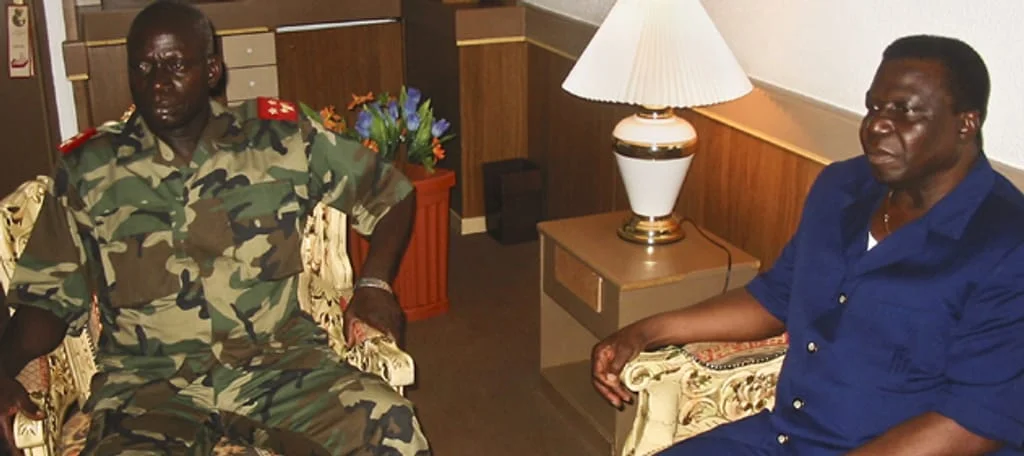
Augusta Conchiglia, in Le Monde diplomatique, and a missionary interviewed by the Fides agency then put forward two hypotheses that were not mutually exclusive, seeing in these events either the culmination of a hatred dating back to the repression of Balanta officers in the 1980s, of which Na Waié had been a victim, or a settling of scores linked to drug trafficking, Na Waié having discovered some 200 kg of cocaine in an army headquarters hangar a week earlier. No trial has since established responsibility; the ECOWAS Court of Justice merely condemned the Bissau-Guinean state in 2018 for violating the president’s right to life and his heirs’ right of access to justice.
This impunity feeds a political economy in which the army does more than arbitrate politics. Conchiglia already reported that 674 kg of cocaine seized in 2006 had vanished from a Public Treasury vault after a group of soldiers passed through, and that the Bijagós archipelago, difficult to control, offered Latin American traffickers a platform towards Europe. The maintenance of the SSMGB was not designed to curb this grip.
It is in this climate that last October’s sequence (2026) played out. After the refusal to allow Embaló’s return, the vice-president of the National Electoral Commission, Felisberta Moura Vaz, received on 8 October by General Horta N’Tam, declared that “technically, the conditions will not be in place to hold elections” on 6 December, while specifying that announcing a postponement falls solely within the competence of the transitional president; the same day, Prime Minister Ilídio Vieira Té observed that “no political party is yet in ideal conditions to go to the polls”, the leadership of most of them being, in his view, “lapsed”, and no candidacy had yet been registered.
The postponement, not yet officially pronounced as of 9 October, is a de facto certainty, with no new date put forward. The Constitution approved by referendum on 30 August, with 70% “yes” on a supposed 62.6% turnout and which the PAIGC had called on voters to boycott, moved the country from a semi-parliamentary regime to a strong presidential one; it now awaits an election to take effect, with nothing to indicate when or to whose benefit. The technical difficulties are real, while the argument of lapsed party leaderships, advanced by a transitional government at the end of a year during which restrictions on political activity remained in force, nonetheless illustrates a well-known mechanism of military transitions, that of a power invoking the unpreparedness of actors it has itself prevented from preparing.
The volume edited by Patrick Chabal and Toby Green nonetheless invites us not to take the “narco-state” label for an explanation — the quotation marks in its title make clear enough that it is an external label. Hassoum Ceesay argues that it was not drugs that made Guinea-Bissau a failed state, but the state’s prior fragility that made it the ideal hunting ground for traffickers, a fragility their presence then aggravated. Simon Massey describes the army’s breaking of the “elite bargain” between soldiers and politicians, which the rents from cocaine transit then sustained; he notes that since the first multiparty election of 1994, no elected government had completed its term, each military intervention, backed by political rivals of the incumbent, opening a new “transition”. Above all, he shows that donors’ shift towards a security agenda only hardened the high command’s resistance to reform. The lesson held for the ECOWAS of 2026, and events confirmed it faster than one might have feared. A stabilisation mission preparing to secure an election without touching the political economy of the army renews the transition instead of closing it.
One detail from 2009 lends these developments a particular resonance. On 29 September, Jeune Afrique was still reporting rumours of discontent within the presidential guard, some of whose members had allegedly been disarmed or transferred, which the Interior Ministry presented as mere reassignments; a week later, the disarmament was public and openly assumed by the head of the junta.
Christoph Kohl reports that in January 2009, Tagmé Na Waié had Vieira’s presidential guard disarmed after being attacked by some of its members, a sign of his adversary’s weakening; six weeks later, both men were dead. The parallel allows no prediction, the balance of power in 2026 not being that of 2009 and the former president being out of the country. It merely recalls that the guard is, in Bissau, the place where succession is decided, and that its neutralisation usually precedes the settling of scores rather than ending it. There remains the question of the weapons handed in, or not, at General N’Tam’s call, and of those which, in a country where arsenals have always circulated between barracks, MFDC maquis (accused in February 2022 of being behind the coup attempt against Embaló) and networks, might find their way to the border.
Finally, extra-regional partners must be reckoned with, without losing sight of recent developments which invite us to look beyond the hypothesis of a mere personal link between Moscow and Embaló. After receiving the former president at the Kremlin in February 2025, Russia has also shown interest in the military transitional authorities in the context of preparations for the third Russia–Africa summit. This dual diplomatic opening suggests that Russian interest bears less on a particular leader than on Guinea-Bissau itself as a potential space of projection into the West African Atlantic. Nothing today allows one to see in it the emergence of a security partnership comparable to those observed in the Sahel. The development nonetheless remains significant, showing on this reading that Bissau-Guinean military leaders now have, at least diplomatically, external options likely to reduce their exclusive dependence on ECOWAS. In a context of prolonged transition, this diversification of international interlocutors deserves particular attention.
Banjul: a raw sovereignty, an angry street
In The Gambia, the fissure is both political and social, the ground clearly showing that Barrow’s bid for a third term takes place in a climate of mistrust made visible by several recent episodes. In July 2025, thousands of Gambians demonstrated against corruption, in the wake of suspicions surrounding the sale of assets seized under Jammeh; in September 2025, the dismissal of Auditor General Modou Ceesay, barely three years into a nine-year term, sparked fresh demonstrations and arrests. On the night of 8–9 September 2026, it was the power cuts endured since June that drove thousands of people onto the streets of Greater Banjul, chanting “Barrow must go”; a police station was ransacked, eleven people arrested, and on 11 September the Inspector General of Police banned all unauthorised demonstrations, warning that offenders would be dealt with using “the necessary force”.
It is in this context that the Senegalese military presence ceased to be a consensual subject. On 16 July 2026, at Bulock in the West Coast Region, Senegalese soldiers destroyed the fence of a Gambian military camp without prior consultation; Banjul described the act as “deeply provocative” and “totally unacceptable”, while choosing the diplomatic route, which led on 29 July to a border demarcation agreement. The opposition seized the opportunity, an opponent such as Talib Ahmed Bensouda judging the incident “deeply concerning” and denouncing the government’s silence, while another, Mai Ahmad Fatty, saw it as a “grave and provocative act” against Gambian sovereignty, recalling that “no nation negotiates its sovereignty”. Members of parliament now voice public concern about the country’s security dependence, and Bensouda promises to end ECOMIG within twelve months if elected.
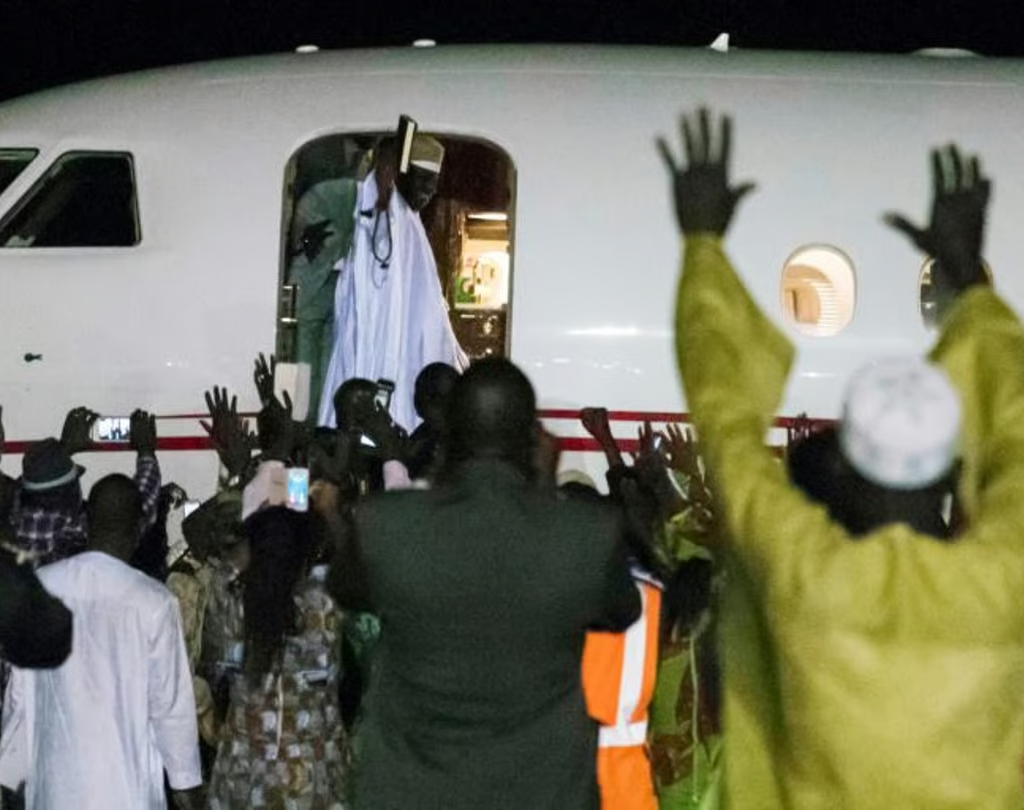
The conjunction of these two registers is the real danger, a presidency contested in the streets on one side and a foreign force with no departure date on the other forming an unstable pair. Should the campaign turn sour, ECOMIG, and through it the Senegalese army, risks appearing to some Gambians not as a guarantor of stability but as the praetorian guard of a third term. An op-ed published by Gunjur Online argues moreover that the mission’s presence, lacking ratification by the National Assembly, is unconstitutional, and recalls the clash of 24 January 2022, on Gambian soil, between Senegalese soldiers and MFDC fighters. The de facto postponement of the Bissau-Guinean election further increases this exposure, the Gambian presidential election of 5 December becoming the only electoral deadline of the fortnight (we have had to revise the analysis) and hence the only regional test of the oligopoly’s capacity to accompany an open contest.
Such a political transition would directly affect the infra-economy of the MFDC maquis. Deprived of its Gambian depth since Jammeh’s departure in 2017, Salif Sadio’s front has fallen back on the Sierragambian military-forest complex. According to sources cited by Al Jazeera, the illegal rosewood trade, shipped from Casamance to the port of Banjul and then to China despite the CITES ban in 2022, constitutes “a main source of income” for the Casamance rebels, to the point of earning this wood the name “conflict timber”; the Westwood company, reportedly linked to Jammeh, is said to have made more than 45 million dollars from it between 2014 and 2017. An alternation in Banjul, by disrupting the customs networks that survived Jammeh, could drive these entrepreneurs of violence towards acts of cross-border destabilisation.
Dakar: from suspect youth to the militarisation of politics
In Senegal, the fissure is institutional. It is a form of cohabitation between an executive power, said to be backed by the constitutional arbiter and seeking its legitimacy, and a legislative power dominated by the parliamentary majority. The conflict between the president and the Pastef parliamentary majority, which we have read through the “2017 transition model”, reaches its tipping point with the opening of the dissolution window on 2 December. The danger is not dissolution itself, a constitutional prerogative, but the temptation to secure a domestic political realignment by drawing on the resources of the oligopoly, namely intelligence, palace alliances with Banjul and Bissau (already problematic) and the narrative construction of an internal/external threat. Many opponents of the President of the National Assembly are eager to see him accused, then convicted, of supposed collusion with the MFDC, an accusation that draws part of its force from prejudices attached to his Casamance origins. This would assign him a rebel identity, that of the Casamançais suspect by nature, whose belonging to Senegal would always remain to be proven.
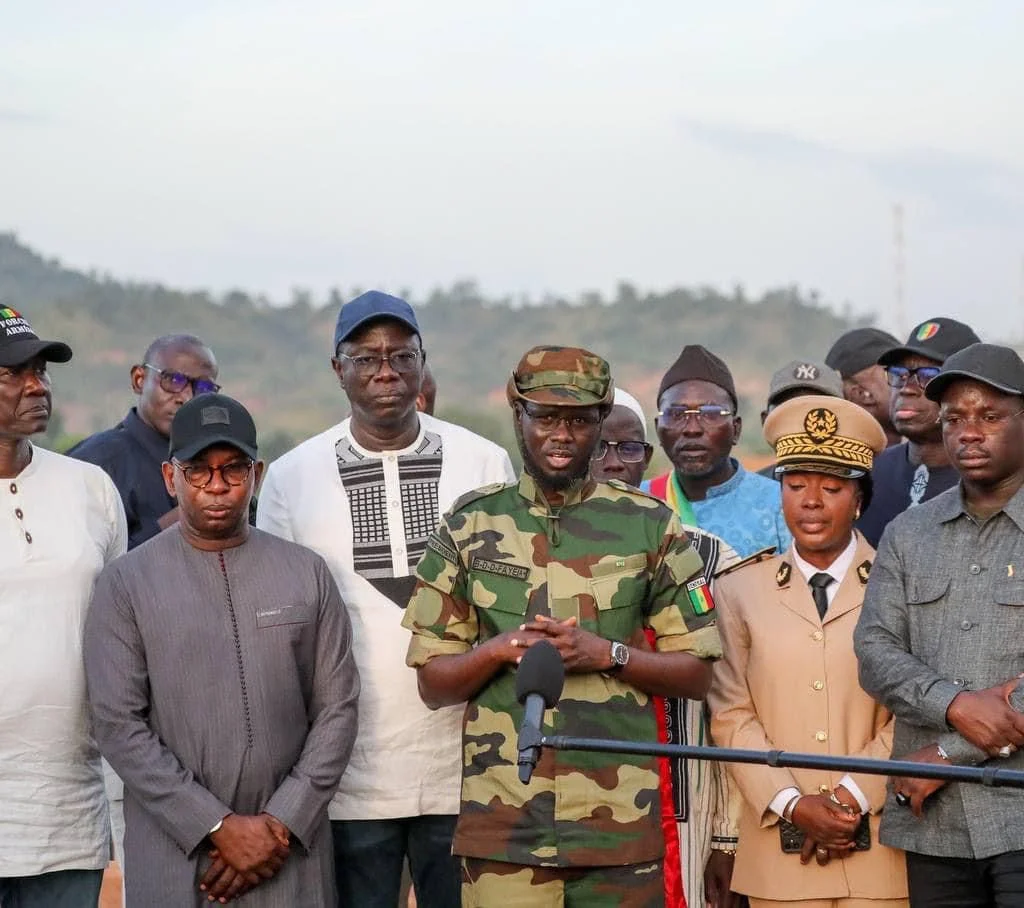
Paradoxically, this temptation has prepared ground (a convenient scapegoat since Abdou Diouf), that of a now-connected youth. Macky Sall had made it a constant rhetorical target, social networks being in his eyes a “cancer of modern societies” and a “global plague”, in the aftermath of the March 2021 riots that left thirteen dead and nearly six hundred injured. In October 2022, before the Dakar International Forum on Peace and Security, he ranked “the excesses of digital technology” among the threats to “peace, security and stability” and promised to put an end to them “one way or another”. The shift is decisive; once online speech becomes a security matter, its repression falls to the security apparatus, and Internet shutdowns, like the closure of Cheikh Anta Diop University in 2023, were its translation. All that would remain would be to link the MFDC and the net guerrilla to turn Senegalese youth into connected rebels. The rebel identity, already attributed to the man through his origin, would then be extended to an entire generation, and political protest presented as an insurgency to be crushed.
Would it be unfair to conflate Bassirou Diomaye Faye’s register with that of his predecessor? When he urges young people, on 29 September 2026, while installing the Youth Advisory Council, not to “waste [their] time on social networks and trivialities”, he is using advice, not threat; but the problem is one of trust in his discourse. Consequently, the continuity of the motif deserves to be noted, the digital space where the youth that carried the 2024 alternation expresses itself being once again presented by the summit of the state as a place of noise and attacks, at the very moment the president is confronting the political formation this youth massively supports. The debate opened on the new press code, like the prosecutions brought in recent years against commentators under successive governments, shows that the securitisation of public speech is a cross-party tendency of the Senegalese state. To a lesser degree than in The Gambia, where the police now ban demonstrations under threat of force, and in no way comparable to Guinea-Bissau, where the army directly arbitrates succession, it is indeed the same slope taking shape, that of turning a political question into a security question. This would be to reproduce in Dakar the matrix that Barrow and Embaló tested at home.
Senegalese diplomacy has moreover just set, addressed to Bissau, a criterion that will apply to itself as well. By asking the transitional authorities to lift restrictions on political and civil activities in order to establish “a climate of trust indispensable” to the credibility of elections, Dakar has stated a norm whose coherence will be judged by its domestic application, at the moment when the 2 December dissolution window opens, as does the question of the very date of the next local elections, and when the status of online speech, from the press code to prosecuted commentators, remains under debate. A mediator demanding of its neighbours what it would refuse its own opponents would lose the one resource the oligopoly cannot provide, that of exemplarity.
The common fault line: Casamance as an adjustment variable
Two mechanisms connect these three fissures. The first is identitarian, the Fulani network structured by Tabital Pulaagu, which we have shown serves as soft-power infrastructure for Macky Sall, Embaló and Barrow, being liable to shift from the cultural to the electoral register in a Bissau-Guinean contest where the memory of the repression of Balanta officers has not faded; our work on Tagmé Na Waié has shown how far ethnic and religious stereotypes are mobilisable political constructions, not essential realities.
It would nonetheless be excessive to present Tabital Pulaagu as a political instrument in the strict sense. Nothing allows it to be equated with a structure of electoral or diplomatic coordination. On the other hand, the network unquestionably constitutes a transnational space of sociability linking administrative, economic, academic, religious and political elites spread across West Africa. Without directly determining political behaviour, it can foster the circulation of ideas, the establishment of relationships of trust and the formation of informal solidarities. From this perspective, its importance lies less in explicit political action than in its capacity to provide a relational environment favourable to certain convergences between leaders sharing common social and cultural references.
The second is functional, by which we mean the MFDC, often associated with the Ajamaat-Joolas, which remains the eternal scapegoat of crises in Bissau and Banjul, designated as the putschists’ accomplice whenever power wavers. Le Journal du Pays, an openly pro-independence outlet whose information is unverifiable as it stands, reports clashes north of Bignona in 2026; whether one takes them as accurate or not, they recall that the conflict is not closed and that it is fuelled by criminal financial flows (in the state’s sense) that largely escape the political control of the capitals.
These flows are nothing new; Ceesay already observed in 2016 that MFDC cadres were using Bissau-Guinean territory to grow cannabis, illegally exploit timber and produce charcoal, most of which ended up in Senegal and The Gambia, and that the December 2011 attack, which cost thirteen Senegalese soldiers their lives, had been prepared on the other side of the border. He also noted that in 2010, according to a treason trial held in Banjul, a mercenary force was training in Guinea-Bissau for a coup against Jammeh without the Bissau-Guinean security apparatus preventing it. Bissau’s instability has never been a domestic affair; it has also been, since the 1970s, a variable in the security of Dakar as well as Banjul.
The prolongation of the Bissau-Guinean transition weighs directly on this fissure. A junta governing in the name of “national security” and the “prevention of any situation likely to threaten the country’s stability”, in the terms reported from its communiqué of 1 October 2026, has an obvious interest in maintaining the image of a border threat. The MFDC in reality reflects the complex relationship that the historical communities of the Casamance region maintain with neighbouring countries whenever an internal conflict breaks out there and spills over. From this point of view, it remains for politicians the most convenient threat to point to, whether to justify maintaining restrictions, the use of state violence or the indefinite postponement of the vote.
Conversely, disarmed or transferred elements of the guard, deprived of a patron who always saw the MFDC behind the various coup attempts against him, might seek in the infra-economy of the forested zones in the north of the country the resources the state no longer provides them. Neither of these two movements is documented to date; their mere possibility suffices to recall that in Bissau, every succession crisis ends up reverberating in Casamance. In this play of mirrors, the rebel identity, reflexively attached to Casamance, would offer everyone a convenient enemy and make its inhabitants permanent suspects on both sides of the border.
Pingback: Une quinzaine de décembre 2026 critique pour la sécurité militaro-politique… – CASɅVANCE